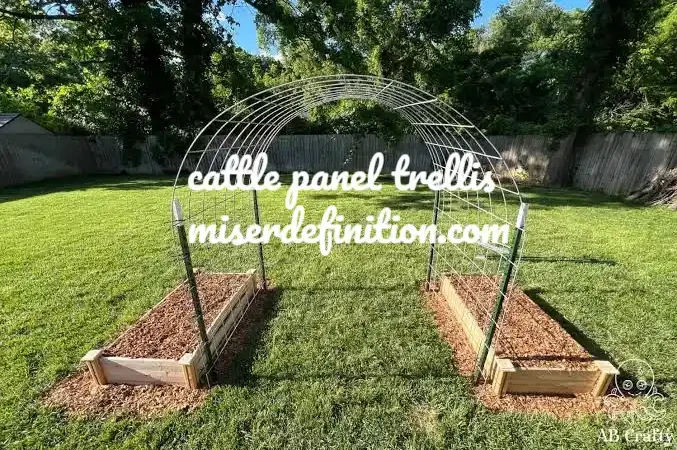
A cattle panel trellis is one of the simplest ways to add vertical growing space to a vegetable garden without building an expensive custom structure. A rigid livestock panel can be supported between sturdy posts or bent into an arch to create a practical garden trellis, walkway arbor, or attractive entrance to a garden.
The basic idea is straightforward: install two strong supports, bend or position a cattle panel between them, secure the panel firmly, and train climbing plants onto the wire grid. The result can support crops such as cucumbers, pole beans, gourds, some melons, and vining tomatoes while moving much of their growth off the ground.
Extension gardening guidance supports vertical growing as a useful way to make better use of limited garden space. Trellising can also make some crops easier to inspect and harvest.
What Is a Cattle Panel Trellis?
A cattle panel trellis is a garden support made from a heavy welded-wire livestock panel. Unlike lightweight decorative trellises, cattle panels are designed for agricultural fencing, so they can provide a rigid framework for vigorous climbing plants.
A common U.S. cattle panel is approximately 16 feet long and 50 inches high, although dimensions, wire gauges, mesh patterns, and weights vary by manufacturer. Current retail examples include galvanized panels made from heavy-gauge welded steel.
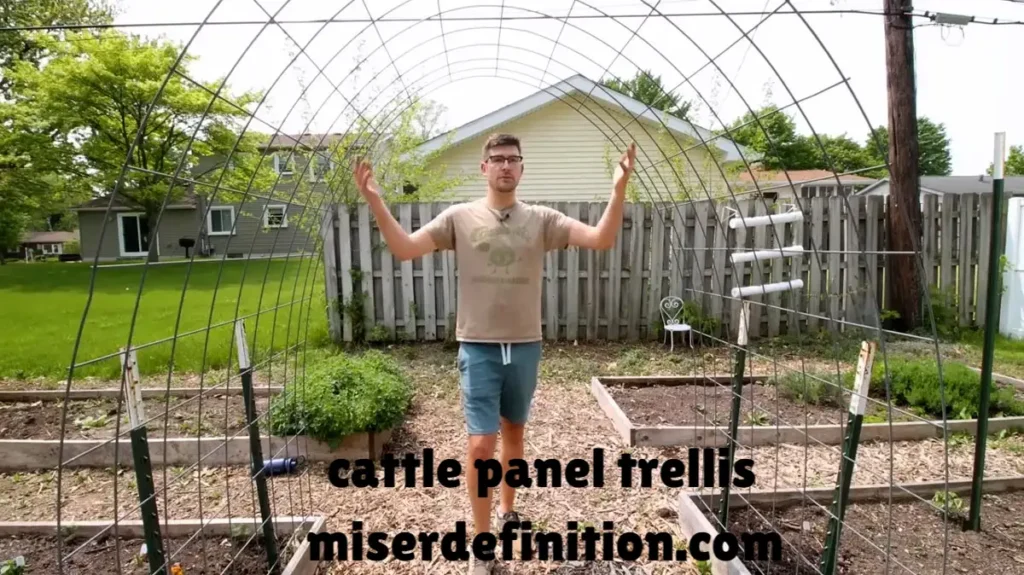
When a long panel is bent into an upside-down U, it becomes a cattle panel arch or trellis arbor. Plants can climb both sides and eventually cover the structure with foliage.
This makes the same basic material useful for:
- Vegetable trellises
- Raised bed trellises
- Garden walkway arbors
- Cucumber trellises
- Pole bean trellises
- Tomato supports
- Gourd structures
- Small-fruited melon supports
- Decorative garden archways
- Vertical garden projects
Why Use a Cattle Panel for a Garden Trellis?
The biggest advantage is strength. A cattle panel is considerably more substantial than many inexpensive garden netting products, making it suitable for vigorous vines when properly anchored.
Other advantages include:
- Large growing surface: A long panel provides considerable vertical space.
- Reusable structure: Galvanized steel can remain in the garden for multiple seasons.
- Simple installation: The panel can be attached to T-posts or another suitable support system.
- Easy plant training: Vines can be guided through the large grid openings.
- Good accessibility: Fruits hanging from an arch can be easier to see and harvest.
- Space efficiency: Vertical growing moves vines upward rather than allowing them to spread across the soil.
- Multiple configurations: The panel can be installed flat, angled, or arched.
- Relatively low material cost: A basic structure can be assembled without elaborate carpentry.
University of Minnesota Extension notes that trellising can help gardeners grow long-vined crops in smaller spaces, while Utah State University Extension specifically describes fencing panels and arbors as useful materials for vertical gardening.
What Materials Do You Need?
For a basic DIY cattle panel trellis, gather:
| Material or tool | Purpose |
|---|---|
| Cattle panel | Main trellis surface |
| Two or more sturdy T-posts | Main structural support |
| Metal wire or heavy-duty ties | Secures panel to posts |
| Wire cutters | Cuts fencing wire or ties |
| Work gloves | Protects hands from sharp wire |
| Post driver | Drives T-posts into firm ground |
| Garden mallet | Useful for lighter installation tasks |
| Measuring tape | Helps position posts accurately |
| Optional additional posts | Adds stability for wide or heavily loaded structures |
A 16-foot cattle panel is a popular option for an arched structure because its length provides enough material to span a garden path while leaving the ends available for anchoring.
However, don’t assume every cattle panel has the same specifications. Current products vary in gauge, mesh spacing, height, weight, and price. For example, Tractor Supply currently lists a 16-foot by 50-inch galvanized panel, while Agri Supply lists comparable 16-foot by 50-inch panels with different wire specifications.
How to Build a Cattle Panel Trellis Step by Step
Building one is easier when you plan the location before moving the panel.
1. Choose the trellis location
Select a location with enough sunlight for the crops you intend to grow.
A cattle panel arch works especially well:
- Between two raised beds
- Across a garden walkway
- At the entrance to a vegetable garden
- Along the edge of a garden
- Between two planting areas
Leave enough room for people to walk beneath the finished structure and for plants to hang without blocking the pathway.
Also consider wind exposure. An arch covered in mature vines can catch significantly more wind than an empty wire panel.
2. Measure the corners and post placement
Mark where the two sides of the trellis will stand.
For a walkway arbor, measure the pathway first. The distance between the posts determines how much the panel bends and how high the finished arch becomes.
Do not simply place the posts wherever the panel happens to reach. Design the opening around the space people actually need to walk through.
3. Drive the T-posts into the ground
Drive the T-posts deeply enough to provide a stable foundation.
The exact depth depends on soil conditions, structure size, and expected loads. Extension guidance emphasizes that stakes need to be driven deeply enough to prevent a trellis from tipping, particularly in strong winds.
For a permanent trellis structure, firm soil and good anchoring are more important than simply making the posts look tall above ground.
4. Bend the cattle panel into a U-shape
This is the step that turns a flat panel into an arched trellis.
A 16-foot panel is large and springy, so don’t attempt to bend it casually by yourself. Having another person help control the panel makes installation considerably easier.
Position one end near the first pair of posts, gradually bend the panel upward and across, then bring the other end down toward the opposite posts.
The finished structure should resemble an upside-down U.
5. Secure the cattle panel to the T-posts
Once the panel is positioned correctly, attach it securely to the posts with metal wire, heavy-duty fencing ties, or another appropriate outdoor fastening system.
Fasten the panel at multiple points rather than relying on one connection near the top.
Check that:
- Both sides are evenly positioned.
- The panel is not pulling a post sideways.
- The bottom edges are stable.
- The arch does not wobble excessively.
- There are no exposed sharp wire ends where people will walk.
6. Test the structure before planting
Push gently against the trellis from several directions.
If it moves significantly, strengthen the posts or add additional supports before planting.
This is much easier than trying to repair a structure after it has become covered with vines.
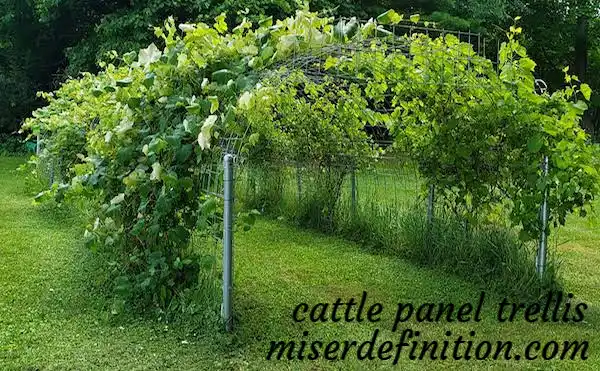
How to Build an Arched Cattle Panel Trellis Over a Walkway
A cattle panel trellis arbor is particularly attractive when used over a garden path.
The basic layout is:
Raised bed → support post → curved cattle panel → support post → raised bed
The panel creates an overhead growing surface while the planting beds remain on both sides.
As vines mature, they can cover the arch and turn a simple wire structure into a leafy garden tunnel.
For a walkway, prioritize clearance and stability. Avoid placing the arch so low that mature vines interfere with people’s heads or shoulders.
A walkway arbor also benefits from additional anchoring because wind pressure increases as the foliage becomes dense.
How Much Does a DIY Cattle Panel Trellis Cost?
The cost depends heavily on the panel type, local supplier, post quantity, fasteners, and whether you already own the tools.
As of September 2026, current U.S. retail examples show that a 16-foot by 50-inch galvanized cattle panel can be found around the $30–$40 range at some farm and hardware retailers, although prices vary by store, region, gauge, and availability. Tractor Supply currently lists one 16-foot by 50-inch model at $37.99, while Agri Supply lists a comparable panel at $39.99 for smaller quantities.
An 8-foot panel can also be an option for a smaller garden. Current retail listings show 8-foot by 50-inch panels as another size choice.
A realistic budget should include:
- Panel
- Two or more T-posts
- Wire or heavy-duty ties
- Optional additional anchors
- Any tools you need to purchase
Tip: Compare the total project cost rather than only the cattle panel price. A cheap panel isn’t necessarily a bargain if you need extra supports, delivery, or specialized tools.
How Does an Arched Trellis Save Garden Space?
An arched trellis changes the direction in which a plant grows.
Instead of allowing a cucumber, bean, or vine to spread several feet across the soil, you train it upward and over the support. This is the basic principle behind garden vertical growing.
Illinois Extension recommends vertical cropping for crops such as pole beans, peas, cucumbers, squash, and gourds because vertical support can make better use of limited garden space.
A cattle panel can therefore be especially useful in:
- Small backyard gardens
- Raised-bed gardens
- Narrow side gardens
- Intensive vegetable gardens
- Urban gardens
- Garden pathways
The key is choosing plants that are actually appropriate for vertical training.
What Plants Grow Best on a Cattle Panel Trellis?
Not every crop should be treated the same way.
Cucumbers
Cucumbers are one of the best choices for a cattle panel trellis. Many vining varieties climb readily, and vertically trained cucumbers can produce straighter fruit while using less horizontal space.
Pole Beans
Pole beans naturally climb and are excellent candidates for a sturdy wire trellis.
Once the vines find the panel, they can spread across the structure without requiring elaborate tying.
Gourds
Gourds can produce vigorous vines, making a strong panel valuable. Illinois Extension has also documented luffa grown over a cattle panel bent into a U-shape above a garden path.
Tomatoes
A cattle panel can function as a tomato trellis, particularly for indeterminate varieties, but tomatoes generally need more active training and tying than naturally climbing crops.
Don’t assume a tomato will automatically climb through the grid. Guide stems and branches as necessary.
Melons
Some smaller melons can be grown vertically, but fruit support matters. University of Minnesota Extension recommends supporting developing melon fruit with slings when necessary because ripe fruit can detach from the vine.
Small Pumpkins and Squash
Use caution here. Small-fruited varieties may be suitable for trellising, but large pumpkins and heavy winter squash can overload a structure or break vines.
University of Minnesota Extension specifically advises that larger squash and pumpkins are generally too heavy to trellis.
Grapes
Grapevines can use strong trellis systems, but a cattle panel is not automatically the best long-term vineyard structure. Grapes become woody and heavy, so a purpose-built permanent grape trellis may be more appropriate for a serious planting.
How to Protect a Cattle Panel Trellis From Wind and Storms
A strong panel does not automatically mean a strong trellis.
The biggest mistake is concentrating on the wire while underestimating the anchors.
For better stability:
- Use sturdy posts.
- Drive posts firmly into the ground.
- Keep the structure balanced.
- Add additional posts for larger or heavily planted structures.
- Check connections before vines become heavy.
- Inspect the structure after severe weather.
- Consider removing or reducing temporary loads if a major storm is forecast.
This matters because a mature vine-covered trellis behaves differently from an empty frame. The foliage increases the surface area exposed to wind.
Extension guidance similarly emphasizes adequate stake depth and support based on the crop, structure, and wind conditions.
How Does a Trellis Improve Plant Access?
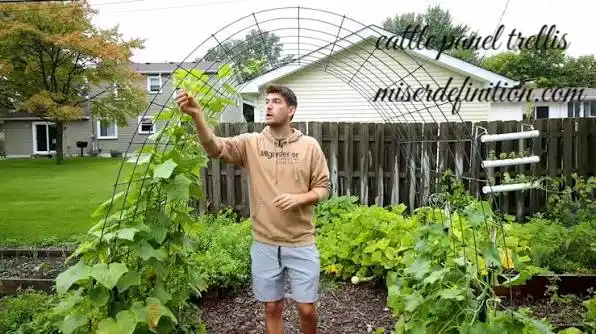
A well-designed trellis can make it easier to see leaves, flowers, and fruit.
Instead of searching through a sprawling mass of vines on the ground, you can inspect plants along the wire surface. This can make harvesting and routine monitoring more convenient.
Vertical growth can also improve airflow around some plants and reduce direct contact between fruit and soil. Extension guidance notes that trellising can help prevent disease and make plants easier to monitor.
However, a trellis is not a disease-prevention guarantee. Plants still need appropriate spacing, watering, sunlight, sanitation, and pest management.
Cattle Panel Trellis Ideas for Different Gardens
Here are several practical configurations:
1. Classic Garden Arch
Bend one panel over a garden path and grow cucumbers or beans on both sides.
2. Raised Bed Trellis
Place a panel along the edge of a raised bed and train vines upward.
3. Double Archway
Use two panels to create a wider or longer tunnel effect.
4. Tomato Support
Install the panel vertically behind a row of indeterminate tomatoes and tie plants to the structure as they grow.
5. Gourd Arbor
Create an overhead arch for vigorous gourds, allowing mature fruit to hang beneath the foliage.
6. Small Melon Trellis
Grow suitable small-fruited melon varieties vertically and add individual slings beneath developing fruit.
7. Garden Entrance
Place an arched trellis at the entrance to turn a functional vegetable support into a garden feature.
8-Foot vs. 16-Foot Cattle Panel: Which Should You Choose?
For a compact project, an 8 ft cattle panel trellis can be easier to handle and may work better in a small garden.
A 16-foot panel provides much more length and is particularly useful when creating a large cattle panel arbor.
Choose based on:
- Garden size
- Desired arch width
- Available height
- Number of plants
- Wind exposure
- Ability to transport and handle the panel
- Number of support posts required
The larger panel is not automatically better. A smaller, well-anchored trellis can be more practical than an oversized structure in a confined garden.
source: joegardener.com
source: migardener.com
Where Can You Buy Cattle Panels?
Cattle panels are commonly sold through farm-supply stores, fencing suppliers, agricultural retailers, and some home-improvement outlets.
Examples include Tractor Supply Co. and Agri Supply, both of which currently list cattle panels in common 16-foot sizes.
You may also find panels from local farm-and-fence suppliers. Availability, gauge, dimensions, and prices vary by region.
For online searches such as cattle panel trellis Amazon, be careful to distinguish between an actual livestock panel and a decorative garden trellis marketed using similar terminology. A genuine cattle panel is typically a rigid welded-wire livestock fencing product.
When shopping, check:
- Length
- Height
- Wire gauge
- Mesh opening
- Galvanized finish
- Weight
- Delivery requirements
- Local pickup availability
How to Save Money on a DIY Trellis
A homemade trellis can be affordable, but the cheapest possible materials are not always the best choice.
To control costs:
- Buy standard panel sizes.
- Compare farm-supply prices locally.
- Reuse existing sturdy posts when appropriate.
- Purchase fasteners in bulk.
- Build one structure that serves multiple crops.
- Use a smaller panel when your garden doesn’t require a full 16-foot structure.
- Buy during seasonal fencing promotions when available.
Also consider the cost of transportation. Large panels can be awkward to move, and some suppliers classify them as oversized or big-and-bulky products.
Common Mistakes to Avoid
Using weak supports
A heavy panel covered with vines needs more support than an empty panel.
Ignoring the mature plant size
Plan for the final weight and spread of the crop, not just the small seedlings you plant today.
Trellising oversized fruit
Large pumpkins and heavy squash can become unsafe or damage vines. Choose smaller varieties when appropriate.
Installing the structure after plants are established
It’s much easier to install the support before vigorous vines become tangled.
Leaving sharp wire exposed
Cut fencing ends can be hazardous. Bend, cover, or otherwise secure exposed wire.
Forgetting maintenance
Check ties, posts, and connections during the growing season, especially after heavy wind.
Final Thoughts
A cattle panel trellis is a practical DIY solution for gardeners who want strong vertical support without constructing a complicated wooden arbor. With a cattle panel, sturdy posts, appropriate fasteners, and thoughtful placement, you can create everything from a simple vegetable trellis to an impressive garden walkway arbor.
For most backyard gardens, cucumbers, pole beans, suitable gourds, and selected small-fruited melons are particularly useful choices. Tomatoes can also work with additional training, while large pumpkins and heavy squash require more caution.
The most important lesson is simple: design the support around the mature plant and the local growing conditions, not just the empty panel. A well-anchored structure installed before the vines take off will be safer, easier to maintain, and much more useful throughout the growing season.
Custom FAQ: Cattle Panel Trellis
What are some cattle panel trellis ideas?
Popular ideas include a cattle panel arch over a garden walkway, a vertical cucumber trellis beside a raised bed, a pole bean support, a tomato training panel, and a gourd arbor. For a decorative approach, grow vigorous vines over an entrance to create a living garden archway.
Can I make a cattle panel trellis arch?
Yes. A long cattle panel can be bent into an inverted U-shape and secured to sturdy supports on both sides. A 16-foot panel is a common choice for larger arches, while shorter panels can work for smaller spaces.
Is an 8 ft cattle panel good for a trellis?
Yes. An 8-foot panel can be a good choice for a compact garden, raised bed, or smaller vertical support. It is easier to handle than a full-length panel but provides less material for a large arch.
Where can I buy a cattle panel trellis?
You can buy the components for a cattle panel trellis from farm-supply stores, fencing suppliers, agricultural retailers, and some home-improvement stores. Retailers such as Tractor Supply Co. and Agri Supply currently list cattle panels in common sizes.
Can I buy a cattle panel trellis on Amazon?
You may find ready-made garden trellises and cattle-panel-style supports on Amazon, but listings can differ significantly from genuine livestock fencing. If you want the strength of a true cattle panel, check the dimensions, wire gauge, mesh construction, and material rather than relying only on the product title.
What plants grow best on a cattle panel trellis?
Cucumbers, pole beans, peas, gourds, and some smaller melons are strong candidates. Indeterminate tomatoes can also be trained on sturdy wire support. Large pumpkins and heavy squash should generally remain on the ground unless you are using an appropriate variety and purpose-built support.
How do I secure a cattle panel to T-posts?
Position the panel against the posts and attach it at multiple points using suitable metal wire, fencing ties, or heavy-duty outdoor fasteners. Make sure the posts themselves are firmly driven into the ground before the panel is loaded with vines.
How long does a cattle panel trellis last?
There is no universal lifespan because it depends on the panel’s steel gauge, galvanizing, soil and weather exposure, installation, and maintenance. Galvanized welded-steel panels are designed for demanding agricultural use, so a properly installed panel can be a long-term garden structure.
Also Read