Introduction: A Story You Will Never Forget
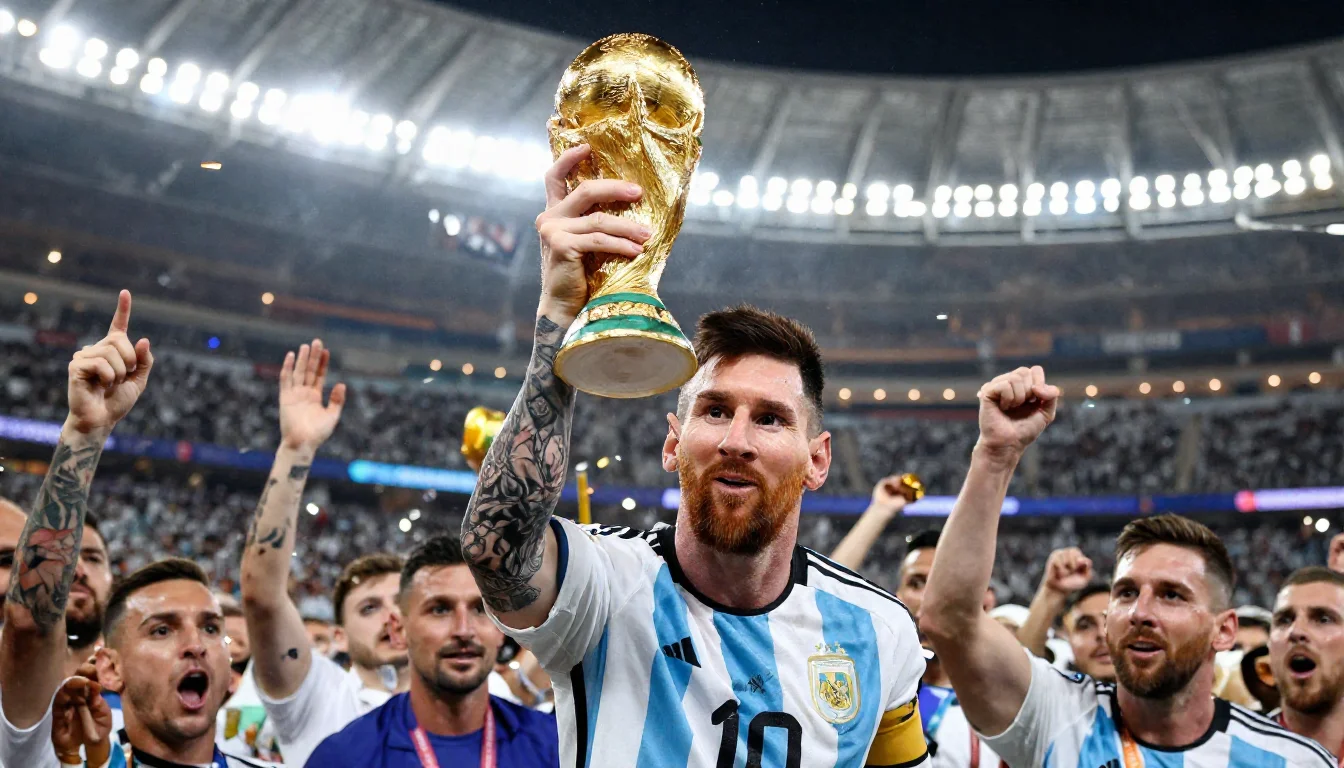
You have watched thousands of football matches in your life. But if you ask any true fan what the single most emotional moment in modern football history was, the answer will almost always be the same — Lionel Messi lifting the World Cup trophy at Lusail Stadium on December 18, 2022.
The Messi World Cup journey is not just a sports story. It is a human story. It is about patience, pressure, failure, tears, and finally, the most beautiful redemption you will ever witness in your lifetime.
For 16 long years, the world watched one of the greatest footballers ever born struggle at the biggest stage of them all. Critics called him a flat-track bully. Rivals questioned his love for Argentina. Fans debated whether he could ever match Diego Maradona. And through all of that noise, Messi kept going.
This article takes you through every chapter of his World Cup career, from a shy 18-year-old substitute in 2006 to a 35-year-old captain who conquered the world in 2022. You will find stats, records, emotional moments, and honest answers to the questions every football fan asks.
Let us begin.
Messi World Cup Debut: Germany 2006
The World Meets a Teenager
In 2006, most football fans outside Spain had barely heard of Lionel Messi. He was just 18 years old and walking into his first World Cup in Germany as an exciting but largely untested teenager.
He was not even a starter. Argentina had a strong squad, and Messi came off the bench in their second group game against Serbia and Montenegro. What happened next gave the world its first proper taste of what was coming.
He entered the pitch in the 74th minute. Within minutes, he assisted Hernan Crespo for Argentina’s fourth goal. Then he latched onto a Carlos Tevez pass and added a sixth himself. In under 20 minutes as a substitute, Messi had announced himself on the world stage.
Argentina made it to the quarterfinals in 2006 before losing to Germany on penalties. Messi did not play in that shootout, a decision that angered fans back home. His tournament ended quietly. But his talent was impossible to ignore.
Key takeaway from 2006:
- Messi was just 18 years old at his debut
- He scored his first World Cup goal against Serbia and Montenegro
- He became Argentina’s youngest-ever World Cup scorer at the time
- Argentina exited in the quarterfinals, eliminated by Germany
South Africa 2010: The Silent Tournament
Big Expectations, Zero Goals
By 2010, Messi was no longer a secret. He was already being called the best player in the world. South Africa was supposed to be his coming-out party at the World Cup.
It did not go that way.
Messi played every minute for Argentina in South Africa. He was the focal point of every attack. But the goals never came. He finished the 2010 World Cup with zero goals from five matches.
That did not mean he played badly. Argentina actually looked very strong throughout, and Messi was involved in most of their attacking play. But the final stat — no goals — was all anyone remembered.
Argentina lost in the quarterfinals. Again to Germany. A 4-0 demolition that shocked the world and ended Diego Maradona’s time as head coach. For Messi, it was another painful early exit on the biggest stage.
Key facts from 2010:
- Messi scored zero goals in five matches
- Argentina reached the quarterfinals
- Germany eliminated Argentina again, this time 4-0
- Maradona was Argentina’s coach during this tournament
Brazil 2014: So Close Yet So Far
The Painful Final That Broke a Nation
If 2010 was quiet, then 2014 in Brazil was heartbreaking in the most devastating way possible.
Messi arrived in Brazil with renewed hunger. He scored four goals in the group stage, including a stunning last-minute winner against Iran that sent Argentine fans into a frenzy. He was the best player of the first three weeks of the tournament without question.
Argentina marched through the knockout rounds. They beat Switzerland, Belgium, and the Netherlands in a dramatic penalty shootout semifinal. Messi was not always at his brilliant best in the knockouts, but he carried his team through sheer will and decisive moments.
Then came the final against Germany in the Maracana. Ninety minutes of tension. Thirty minutes of extra time. And then Mario Gotze’s 113th-minute goal broke Argentina’s heart.
Messi received the Golden Ball as the best player of the tournament. He accepted the award with a look on his face that told the entire story. Winning an individual award when your team loses the final feels like cold comfort. And for Messi, it was.
Key facts from 2014:
- Messi scored 4 goals and won the Golden Ball award
- Argentina reached the World Cup final for the first time since 1990
- Germany beat Argentina 1-0 in extra time in the final
- This was Messi’s first World Cup Golden Ball win
Russia 2018: The Low Point
The Tournament That Almost Broke Him
Russia 2018 was, without a doubt, the lowest point of Messi’s international career.
Argentina barely qualified. Messi almost single-handedly dragged them to the tournament by scoring a hat-trick against Ecuador in the final qualifying game. Without that performance, Argentina would not even have made it to Russia.
The tournament itself was a disaster. Argentina drew with Iceland in their first game, and Messi missed a penalty. They then lost 3-0 to Croatia and were on the brink of elimination. They scraped through the group stage and then faced a young France team in the round of 16.
Despite Messi providing two assists in that 4-3 loss, France’s pace and the rise of Kylian Mbappe proved too much. Argentina was out. One goal and one tournament exit at the round-of-16 stage.
At this point, many people genuinely believed Messi would never win a World Cup. The debate about his legacy versus Maradona’s reached its loudest and most critical point. Some fans questioned whether he truly cared about playing for Argentina.
Key facts from 2018:
- Messi scored just one goal across four matches
- Argentina crashed out in the round of 16
- France eliminated Argentina 4-3
- Messi missed a penalty against Iceland in the group stage
Qatar 2022: The Greatest World Cup Performance Ever {#2022}
The Redemption Story of a Generation
If 2018 was the bottom, then 2022 in Qatar was the mountaintop.
Everything about the 2022 World Cup felt different for Messi. He came in as a 35-year-old captain with grey in his beard and fire in his eyes. Most analysts agreed this was his last chance. The weight of that reality hung over every match.
And then something remarkable happened. Messi did not crack under the pressure. He thrived.
The Shock Loss to Saudi Arabia
Argentina’s tournament began with a nightmare. They lost 2-1 to Saudi Arabia in the group stage, one of the biggest upsets in World Cup history. Messi had scored from the penalty spot, but it was not enough.
For 24 hours, the entire sporting world held its breath. Was this it? Would Messi’s final World Cup end in group-stage humiliation?
The Comeback
What followed was nothing short of extraordinary. Argentina won every single game after that Saudi Arabia shock. Messi scored in six of Argentina’s seven matches. He led attacks, created chances, won penalties, and produced moments of individual brilliance that left defenders helpless.
His assist against Croatia in the semifinal stands as one of the greatest individual moments in World Cup history. He dribbled past Josko Gvardiol, one of the best young defenders in the world, as if he were a training cone, and then slipped the ball to Julian Alvarez for the goal.
The Final Against France
The final on December 18, 2022, was the greatest World Cup match ever played.
Argentina led 2-0 with ten minutes remaining. Then France’s Kylian Mbappe scored two goals in two minutes to level the match. Argentina came back through Messi’s strike in extra time. Mbappe equalized again from the spot. It finished 3-3 after extra time.
In the penalty shootout, Messi stepped up and converted. Argentina won 4-2 on penalties. And then, after 36 years of waiting, Argentina were World Champions again.
Messi scored seven goals and provided three assists at Qatar 2022. He became the first player in history to score in the round of 16, quarterfinals, semifinals, and final at the same World Cup. He won the Golden Ball as the best player of the tournament.
He was also 35 years old.
Key stats from Qatar 2022:
- 7 goals scored across 7 matches
- 3 assists provided
- Scored in 6 of Argentina’s 7 games
- First player to score in the last four knockout stages at a single World Cup
- Won the Golden Ball award (his second after 2014)
- Played every single minute of Argentina’s campaign (690 minutes total)
Messi World Cup Stats and Records
Here is a complete picture of Messi’s World Cup record across five tournaments.
Career World Cup Stats
| Tournament | Matches | Goals | Assists | Result |
|---|---|---|---|---|
| Germany 2006 | 3 | 1 | 1 | Quarterfinal |
| South Africa 2010 | 5 | 0 | 1 | Quarterfinal |
| Brazil 2014 | 7 | 4 | 1 | Runner-up |
| Russia 2018 | 4 | 1 | 2 | Round of 16 |
| Qatar 2022 | 7 | 7 | 3 | WINNER |
| Total | 26 | 13 | 8 |
World Cup Records Broken by Messi
- Most World Cup appearances by a single player: 26 matches, surpassing Germany’s Lothar Matthaus
- Most minutes played at the World Cup: Surpassed Italy’s Paolo Maldini
- Only player to win two World Cup Golden Ball awards: 2014 and 2022
- Most Man of the Match awards in World Cup history: 11 awards
- Highest goal contributions (goals plus assists) in World Cup history: 21 total
- First player to assist goals at five separate World Cup tournaments
- Argentina’s all-time leading World Cup scorer: 13 goals, surpassing Gabriel Batistuta’s record
- Most liked Instagram post in history: His World Cup celebration post reached over 65 million likes
Messi vs Maradona: The World Cup Legacy Battle
Two Legends, One Nation, One Trophy
The comparison between Messi and Diego Maradona has defined Argentine football for two decades. And nowhere was that comparison more intense than at the World Cup.
Maradona led Argentina to the World Cup title in 1986, almost single-handedly. His performances in Mexico that year, particularly against England, are among the most celebrated in football history. For many Argentines, Maradona was untouchable.
Messi spent years living in that shadow at the international level. Critics pointed to the World Cup as the missing piece in his legacy.
But look at the numbers side by side. At Mexico 1986, Maradona contributed five goals and five assists. At Qatar 2022 alone, Messi matched that total with seven goals and three assists. And Messi did it at the age of 35.
Furthermore, Messi played in five World Cups across 26 matches compared to Maradona’s 21 matches across four tournaments. Messi finished his World Cup career with 13 goals and 8 assists — 21 total goal contributions. This is the highest in World Cup history.
The honest answer to the Messi vs Maradona debate at the World Cup is that both are legends in their own right. Maradona did it first and did it brilliantly. But Messi’s 2022 performance, at 35, under the weight of an entire nation’s expectations, matched anything Maradona ever produced on the global stage.
Why the 2022 World Cup Win Matters More Than Any Trophy
It Was Never Just About Football
I want to be honest with you here. The 2022 World Cup win was not just a trophy. It was a cultural moment. It was the answer to years of unfair criticism.
For over a decade, people questioned whether Messi truly loved playing for Argentina. They compared his club performances to his international ones and called him inconsistent. They said he could not replicate Barcelona’s form in an Argentina shirt.
What Messi did in Qatar silenced all of that. He played every single minute of the tournament. He led his team through a shocking loss, through moments of panic, through one of the greatest finals ever played. He scored in every knockout round. He converted in the shootout.
And when he lifted that trophy, the whole world recognized what had always been true. Messi had always been extraordinary. He just needed the right moment, the right team, and the right tournament to show it to the world one final time.
His Instagram post after the victory became the most liked post in the history of social media, with over 65 million likes. That number tells you everything about what this moment meant to the world.
FAQs
1. When did Messi win the World Cup? Messi won the World Cup on December 18, 2022, when Argentina beat France 4-2 on penalties after a 3-3 draw in the final at Lusail Stadium in Qatar.
2. How many World Cups has Messi played in? Messi has played in five World Cups: Germany 2006, South Africa 2010, Brazil 2014, Russia 2018, and Qatar 2022.
3. How many goals has Messi scored at the World Cup? Messi has scored 13 goals across 26 World Cup matches, making him Argentina’s all-time top scorer at the tournament.
4. Did Messi win the Golden Ball at the 2022 World Cup? Yes. Messi won the Golden Ball as the best player of the 2022 World Cup. It was his second Golden Ball, having also won the award at the 2014 World Cup in Brazil. He is the only player in history to win the award twice.
5. How many assists did Messi register at the 2022 World Cup? Messi provided three assists at Qatar 2022. His most memorable came in the semifinal against Croatia, where he dribbled past Josko Gvardiol before setting up Julian Alvarez.
6. Did Messi win the Golden Boot at the 2022 World Cup? No. Kylian Mbappe won the Golden Boot with eight goals, including a hat-trick in the final. Messi finished with seven goals.
7. How old was Messi when he won the World Cup? Messi was 35 years old when he won the 2022 World Cup, making his achievement even more remarkable.
8. What records did Messi break at the 2022 World Cup? Messi broke multiple records in Qatar, including most World Cup appearances (26), most Man of the Match awards (11), most goal contributions in World Cup history (21), and most World Cup Golden Ball wins (2). He also became the first player to score in the round of 16, quarterfinals, semifinals, and final of the same World Cup.
9. Did Messi score in the 2022 World Cup final? Yes. Messi scored twice in the final against France — a first-half penalty and a goal in extra time. He also converted his penalty in the shootout.
10. Is Messi the greatest World Cup player of all time? In terms of total goal contributions (21 across 26 matches), Man of the Match awards (11), and becoming a two-time Golden Ball winner, Messi holds the most impressive individual World Cup statistics in history. Whether that makes him the greatest of all time is a debate that football fans will enjoy for generations.
Conclusion
The story of Messi at the World Cup is one of the most compelling narratives in the history of sport. It stretches across 16 years, five tournaments, and a lifetime of emotions.
You watched him debut as a teenager. You saw him go goalless in South Africa. You felt the heartbreak of Brazil 2014. You lived through the low of Russia 2018. And then, finally, you witnessed the most beautiful ending in Qatar 2022.
Messi did not just win the World Cup. He won it in the most dramatic, nerve-shredding, breathtaking way possible. He won it at 35, in his fifth attempt, against a French team that kept coming back from the dead. He won it with every record imaginable attached to his name.
The next time someone asks you whether Messi is the greatest footballer who ever lived, think about that night in Lusail. Think about what it took to get there. Think about what he carried, and what he finally set down when he lifted that golden trophy into the Qatar sky.
What moment from Messi’s World Cup journey do you find the most emotional? Share your thoughts and keep the conversation going.
Author Bio
James Harrington is a sports journalist and football analyst with over 10 years of experience covering international football, FIFA World Cups, and player career retrospectives. He has written extensively about South American football culture, Messi’s legacy, and the global impact of the beautiful game. Based in London, James combines deep statistical knowledge with a conversational writing style to make football stories accessible and engaging for fans worldwide.